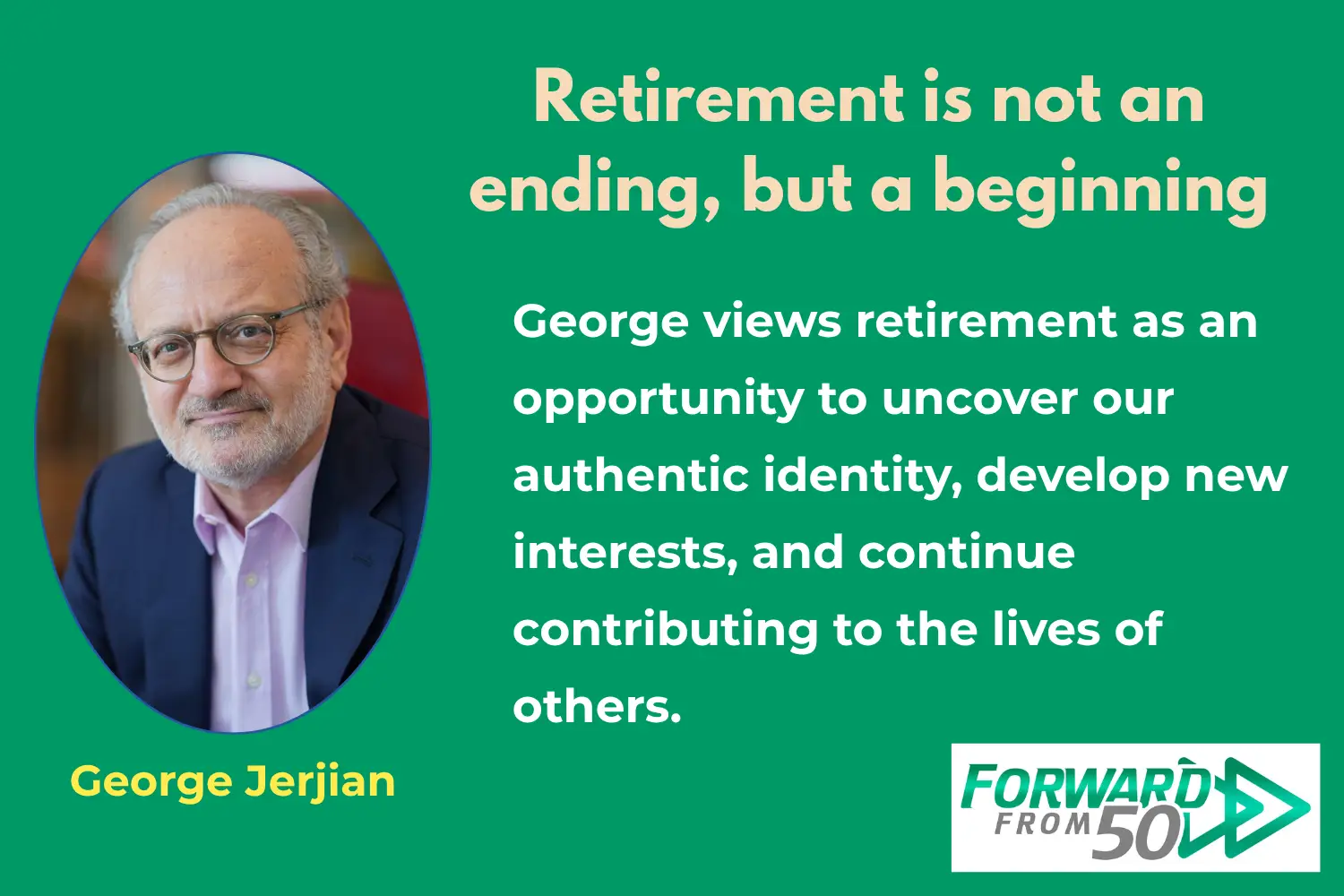
When George Jerjian stepped away from his career at 52 following an illness, he confronted questions that had been easy to ignore when life was busy.
What had his life really been about? Why was he here? Was he making an impact? Most importantly, what would give his life meaning now that his career no longer defined him?
George did not find the answers quickly. He drifted for nine years while trying to figure out what should come next. Yet, that experience eventually helped him discover a new purpose helping other people navigate the same transition.
Today, George is an author and retirement transition expert who encourages people to stop thinking about retirement primarily as an escape from work. Instead, he views it as an opportunity to uncover our authentic identity, develop new interests, and continue contributing to the lives of others.
Losing an identity
George believes one of the greatest challenges people face in retirement is something few anticipate and that is losing their identity.
After surveying people between 55 and 75 in the United States, Canada, United Kingdom, Australia and New Zealand, George discovered health, finances and aimlessness were major concerns. More than 21,000 people completed all nine questions in the survey. When asked what they would change if given a magic wand, 36% selected finding a new purpose.
Yet, George concluded there was something deeper behind the answers that was not obvious. People did not know what they did not know.
“The first casualty in retirement is identity,” he explained.
For decades, people often answer the question “Who are you?” by describing what they do. When that career ends and the title disappears along with the daily responsibilities, people often lose their professional relationships and have a sense that they no longer have a value.
George believes this can leave retirees struggling to understand who they are without their jobs. He experienced that himself after leaving work at 52.
An illness forced George to confront his mortality and questions he had been pushing aside. Once he had what he described as a “rendezvous with death,” he could no longer ignore them.
After a time, rather than viewing that experience as a setback, George realized it was a turning point.
Looking backward to move forward
One of George’s important life lessons is that difficult experiences often open people up to opportunities that would never have existed otherwise.
Years after leaving his career, George participated in a 30-day silent retreat in North Wales. With outside distractions removed, he had time to examine his life and better understand the person he wanted to become.
George describes that process as an internal adventure or “inventure.”
During the retreat, he completed a life audit by thinking about the homes where he had lived from childhood onward. He considered the positive experiences associated with those places as well as difficult periods.
As a writer, George documented what he remembered and identified 12 crises that had occurred throughout his life. Each one became a platform for a new opportunity.
That realization contributed to his book, “Spirit of Gratitude: Crises or Opportunities.”
George learned to view retirement in a similar way. The word crisis does not necessarily describe a catastrophe. It can simply represent a turning point, much like retirement becomes.
Discovering the authentic person
The silent retreat also helped George recognize how much of his earlier identity was constructed to help him succeed as a professional.
He described his younger self as relentlessly ambitious and highly decisive. Yet, George realized that persona was not his authentic self. It was a wall he had constructed to interact with the world while protecting himself emotionally.
Silence forced him to encounter parts of himself he had pushed aside.
That experience offers another lesson for seasoned citizens. Finding meaning in the second half of life may require more than deciding how to fill a calendar. It can involve determining who you really are when professional expectations and other people’s opinions no longer dictate your choices.
George does not suggest everyone needs a 30-day silent retreat. However, he encourages people to invest time in understanding themselves, and to examine the gold nuggets they picked up along the path to this point. That way they can discern who they wish to become and what meaning they wish to ascribe so they can plot the direction of their path for this next chapter.
Moving toward something new
George believes people can become trapped when they try to recreate the lives they had before retirement.
The familiar past feels safer than an uncertain future. However, George encourages people to keep moving forward even when they cannot clearly see where they are going.
He compares the transition to a ship leaving port. As the shoreline disappears and the ship enters open water, there may be periods with no wind, and it appears nothing is happening. Yet, exploration is part of the process.
George believes retirees need a new identity, purpose and community, which may take time to discover.
Meaning also comes from using interests and abilities to benefit other people.
George also believes service creates connection, which can help counter the isolation and loneliness some people experience after leaving the workplace. He encourages people to find something they enjoy and are good at, then look for ways to use it to help others.
Keep expanding
Rather than viewing retirement as a season for gradually withdrawing from life, George encourages people to expand.
That can mean expanding their capabilities, horizons and understanding of what they might still accomplish. Someone who has always been interested in a subject might take classes to learn more about it. Another person might finally develop a skill that was pushed aside during working years.
George believes people who may have decades of life ahead of them should continue investing in themselves.
“You need to be expanding and growing further out,” he said.
Education can open possibilities that did not exist before and give people new ways to contribute their experience to the world.
George developed his DARE program to help people make that transition. The acronym stands for discover, assimilate, rewire and expand.
Part of that process involves challenging internal stories that keep people from moving forward. Thoughts such as “I’m too old” or “It’s too late for me” can become barriers when people accept them as truth.
George believes moving into a new stage of life requires courage, but remaining stuck can represent an even greater risk.
He wrote a book, “DARE To Discover Your Purpose: Retire, Refire, Rewire,” to encourage people to rediscover their identity, rekindle their sense of purpose and, more importantly, to design a life filled with meaning, contribution and possibility.
Don’t postpone life
George put his philosophy into practice in 2024 when he was 69.
As an adolescent, he had always wanted to travel around the world in 80 days. Rather than allowing his dream to die with him, George spent six months planning an epic journey to countries he had never visited.
The experience reinforced one of the most important lessons he shares with people over 50.
“Do your bucket list now,” he explained.
George does not view bucket-list experiences simply as opportunities to check items off a list. Travel, hobbies and other experiences can expose people to new ideas and help them discover interests that could develop into something more meaningful.
“Beyond the bucket list, you will find what you love to do,” he explained. “Then, that will be your new beginning.”
For George, travel should also be intentional. He encourages people to observe, learn and remain open to what experiences can teach them about themselves.
At the end of his 80-day journey, George wrote “Odyssey of an Elder: Around the World in 80 Days.” The book helps others to reflect, grow, question old assumptions and to reimagine the life still waiting to be lived.
Finding answers within
Today, George finds meaning and purpose by helping other people make the transition he struggled to navigate himself.
He offers a free Taster course as well as eight-week prerecorded and live programs. Participants in all his courses work through his exercises that eventually produce a one-page life plan they can use as they continue exploring, changing and moving forward.
However, George does not claim to have the answers for other people. In fact, that may be one of the most important lessons he learned.
People often look outside themselves for someone to tell them what they should do next. George believes the answers are already inside them, although they may be hidden behind fear, expectations and identities developed during the first half of life.
The goal is not simply to retire from something, rather it is to discover something to move toward.
For George, that has meant writing, teaching, traveling, learning and helping others recognize that leaving a career does not mean their useful years are over. It can mark the beginning of an entirely new chapter.
For more information
People can learn more about George, his book, courses and his work as a retirement transition expert, by visiting these platforms:
- Website = www.georgejerjian.com
- LinkedIn = www.linkedin.com/in/georgejerjian
- YouTube = www.youtube.com/@george.jerjian
- Facebook = www.facebook.com/george.jerjian
- Instagram = www.instagram.com/george.jerjian
- X = www.x.com/georgejerjian
George’s books, “Spirit of Gratitude: Crises or Opportunities”, “DARE to Discover Your Purpose:Retire/Refire/Rewire” and “Odyssey of an Elder: Around the World in Eighty Days,” are available on Amazon sites and on his website.
If you order one of George’s books from a link above, Forward From 50 may receive a small commission at no extra cost to you.