Jim Hughes knows firsthand how quickly technology can turn from a useful tool into a threat.
In 2005, a message suddenly appeared on his business computer informing Jim that criminals had taken control of it. They demanded $300 in Bitcoin to release his files and even provided a telephone number he could call for instructions on paying the ransom.
Jim refused to pay and lost all his files. However, the experience eventually helped point him toward a mission that gives his life greater meaning and purpose today.
“I am going to spend the rest of my time learning as much as I can about cybersecurity and how to protect people from identity theft,” Jim recalled thinking.
An epidemic of fraud
Jim described online scams targeting older Americans as an epidemic. He conducts workshops at senior living facilities and for associations to help people recognize how scammers operate.
At one presentation in Franklin, Tenn., a man approached Jim before the workshop and explained that he had recently lost $9,500 after believing he was helping his grandson.
Then the man revealed something even more troubling.
“That’s the second time that has happened to me,” the man said.
Verify before acting
One of Jim’s most important recommendations is also among the simplest. Never send money in response to an incoming request without independently verifying who is asking for it.
Jim developed the “Digital Defense for Seniors” Four Pillar Framework to help Seniors to strengthen their digital defenses against fraud.
Passwords are another important component of digital security. Strong passwords are the front door lock to your digital house.
Many people use the same password for several accounts because it is easier to remember. However, once criminals obtain that password through a data breach, they often try those credentials on other websites.
Jim recommends creating a unique password for every account and using especially strong passwords for financial accounts.
To help people improve their security, Jim created a 13-page guide called “Strong Passwords Made Easy.” The Ultimate Guide normally costs $15, but Jim is offering it free to Forward From 50 listeners and readers through his website. A link is at the bottom.
The danger of secrecy
Some of the most heartbreaking situations Jim encounters involve romance scams.
He described meeting a 66-year-old Nashville businessman who started dating a woman online. Over several months, she persuaded him to invest increasingly larger amounts in Bitcoin.
Eventually, the man lost $520,000, essentially everything he had accumulated.
Jim also encountered an 80-year-old man who lost $1.6 million to a much younger woman he met online. The situation was particularly painful because the man’s 45-year-old son worked professionally in cybersecurity.
The father never told his son what was happening.
That reluctance to discuss relationships or financial decisions is something Jim hopes families can overcome. Embarrassment can make a bad situation worse because victims may remain silent even after becoming suspicious.
Jim noted that losing an entire retirement nest egg affects more than the victim. If seasoned citizens lose the resources needed to support themselves, their adult children may eventually need to assume responsibility for housing, groceries and other necessities.
Finding purpose by helping others
Jim’s work illustrates how a difficult experience can eventually become the foundation for meaningful service.
He did not plan to make cybersecurity education a personal mission. However, his interest grew from experiencing firsthand what it was like to have criminals take control of his computer and destroy valuable information.
The people Jim encounters provide constant reminders of why that mission matters. Behind every financial loss is someone whose independence, security and peace-of-mind may have been permanently altered.
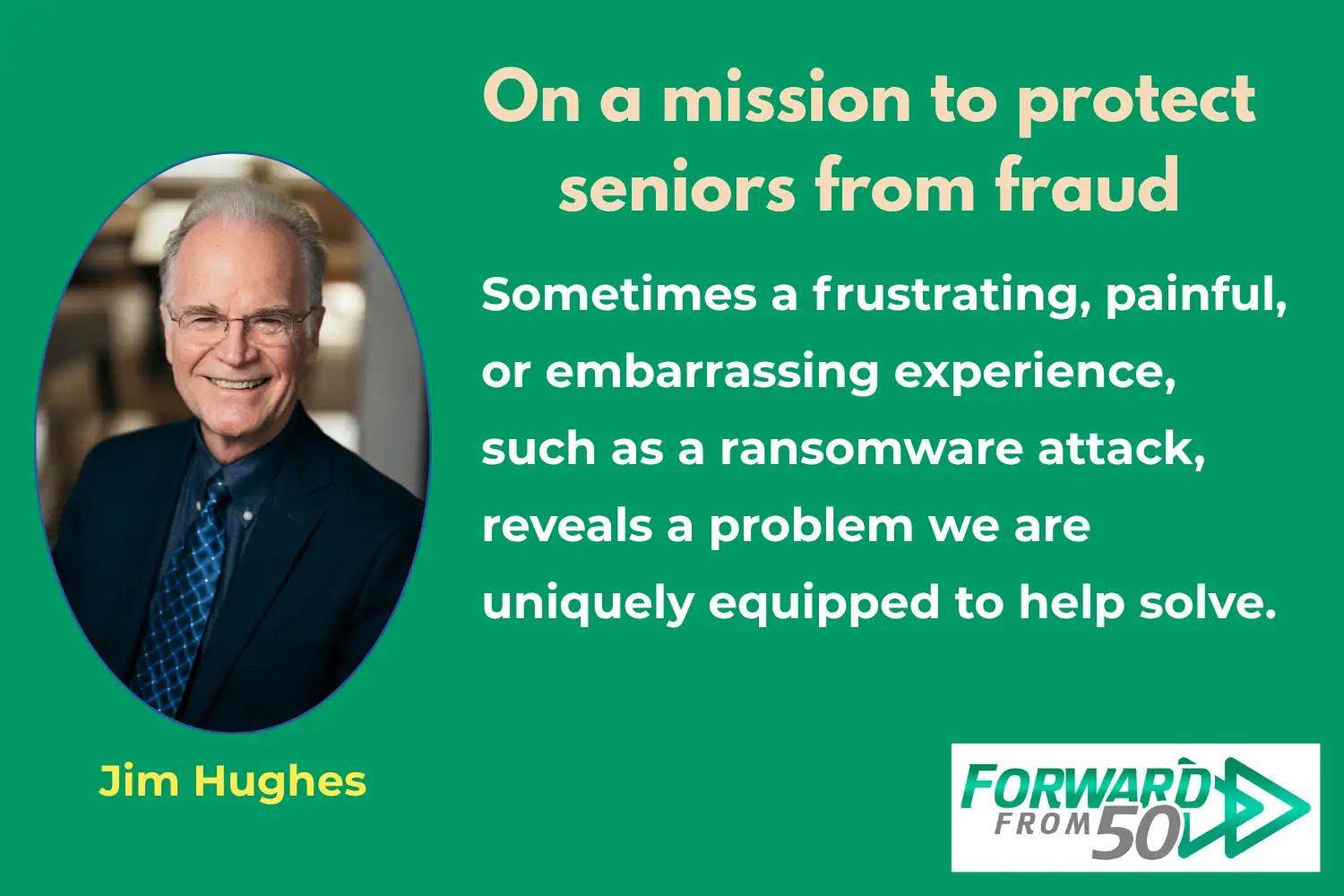
His experience also offers a broader lesson for people moving forward from 50. Meaning and purpose do not always emerge from carefully planned opportunities. Sometimes a frustrating or painful experience reveals a problem we are uniquely equipped to help solve.
Knowledge gained through adversity becomes more valuable when it is used to help someone else.
For seasoned citizens navigating an increasingly complicated digital world, Jim’s message is not to abandon technology. Instead, become educated about the risks and develop habits that make scams less likely to succeed.
Be sure to slow down, ask questions, verify problems independently and talk to someone you trust before sending money.
Most importantly, remember Jim’s simple acronym whenever something online does not feel right – RAP – recognize, avoid and prevent online scams before becoming a victim.
For more information
People can connect with Jim Hughes on these platforms:
- Website = www.seniorrisksolutions.net
- Email = jim@seniorrisksolutions.net
- LinkedIn = www.linkedin.com/in/jimhughesbrs
- Instagram = www.instagram.com/protectingseniorsfromfraud
Jim’s book, “The Digital War: Protecting Seniors from Online Scams, Identity Theft, and Digital Exploitation,” is available at www.seniorrisksolutions.net/product/the-digital-war.
Jim’s free guide, “Strong Passwords Made Easy Ultimate Guide” is available at business-risk-solutions.kit.com/6bebbd373e.