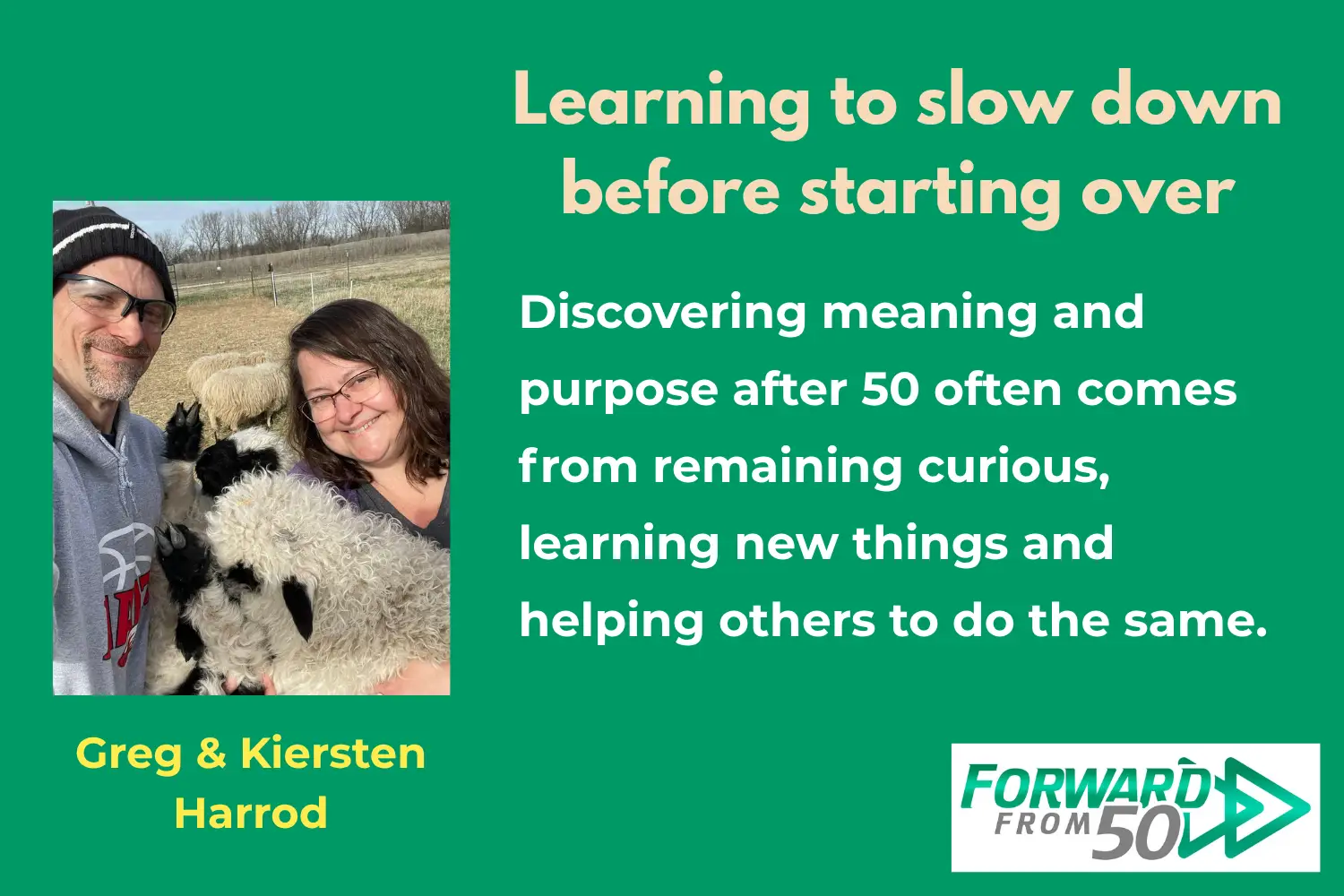
Greg and Kiersten Harrod entered their 50s with decades of experience behind them. Yet, rather than settling comfortably into familiar routines, they chose to become beginners again.
Greg left a career in engineering, manufacturing and corporate leadership to focus on business coaching. Kiersten, who had spent years homeschooling their four children before working as a medical coder, finally pursued a longtime dream involving sheep and fiber arts.
Together, they are building Pemberley Woolworks in their 50s while discovering that meaning and purpose often come from remaining curious, learning new things and helping other people do the same.
Neither Greg nor Kiersten came from an agricultural background. Yet, they now care for 21 sheep while learning how to turn that experience into a sustainable business.
A dream involving four sheep
Kiersten had been involved with fiber arts for decades and dreamed of someday owning sheep so she could use their wool for spinning, knitting and dyeing.
The opportunity arrived when their oldest son called with a proposition. He had land in Illinois and wondered whether his mother was ready to pursue her sheep-owning dream.
They started with four sheep. After Greg and Kiersten made their career changes, they moved to a small town in southeast Kansas where the flock eventually grew to 21.
Today, they have Merino, Babydoll and Valais Blacknose sheep. Kiersten’s love of Jane Austen also influenced the farm. They call it Pemberley Farm, and every sheep has an Austen-inspired name, including Mr. Darcy, Mr. Knightley, Mr. Bingley, Jane, Emma and Lizzy.
The sheep have distinct personalities, too, which Kiersten shares with readers through a weekly newsletter.
But, the animals represent something deeper than an unusual midlife business venture. Caring for them has helped Greg and Kiersten to slow down and pay closer attention to the world around them.
Learning to notice
One lesson Kiersten rediscovered is the importance of observing, rather than simply rushing from one task to another.
She explained that caring properly for sheep requires knowing how individual animals normally behave. One might prefer grazing alone while another rushes toward the feed bucket. Recognizing those patterns makes it easier to notice when something changes.
That lesson applies to people, too.
“We need to pay attention to the people around us,” Kiersten explained.
She remembered an elementary school exercise in which teachers sent students into a field and instructed them to sit alone and pay attention to what they could see, hear and smell.
At first, Kiersten was bored, but she eventually started noticing things.
Decades later, she finds herself doing something similar at Pemberley Farm. She enjoys sitting near the barn, watching the sheep and chickens, listening to the trees and noticing how smells and sounds change with the seasons.
“These are all things that you miss if you’re rushing around,” Kiersten explained.
That realization has become part of the couple’s mission. They want to encourage people to reconnect with the real world, even if they only have five minutes and never venture beyond their own backyard.
Teaching old skills to a new generation
Kiersten’s fiber arts experience has also opened another avenue for creating meaning and purpose, especially by helping homeschool families to introduce children to traditional skills.
As a homeschooling mother, she once taught a 10-week co-op class covering a variety of fiber arts. Students learned spinning, dyeing, weaving and knitting. They even made some of the tools they needed, including knitting needles and drop spindles.
The experience eventually developed into a formal curriculum that could be shared with other families. But, the lessons teach more than fiber arts.
Kiersten recalled watching children become frustrated while attempting difficult skills. Some became angry or nearly cried. Yet, with encouragement, they slowed down, persevered and eventually accomplished something they initially thought they couldn’t do.
At the end of the class, students proudly showed family members what they had created.
One mother told Kiersten that learning to knit alongside her son became one of their best bonding experiences. They watched Kiersten’s instructional videos, worked through the challenges together and eventually mastered the skill.
Kiersten believes there is another important lesson in fiber arts and that is understanding things don’t need to be perfect to have value.
Students contributed individual knitted squares to a class blanket. Some squares had holes and obvious mistakes, but the children didn’t focus on the flaws.
They saw what they had accomplished together.
“We don’t need to be perfect,” Kiersten explained. “We just need to try and embrace that the imperfection is part of the process.”
Families interested in exploring fiber arts can visit beasttoblanket.com. The curriculum includes resources to help people find materials they need.
Greg and Kiersten also offer a free lesson showing people how to dye wool yarn with Kool-Aid at dyeasheep.com. It’s an easy way for people who already knit or crochet to take one step backward in the production process and experience something new.
Helping leaders find clarity
Greg’s new purpose after turning 50 took him in another direction, although the underlying mission is remarkably similar.
He started his career as an engineer and spent about 10 years working for Caterpillar, where he participated in early research involving GPS-guided heavy equipment. He later worked in HVAC manufacturing, program management and business leadership.
Eventually, Greg realized coaching was what he was “built to do.”
Today, he helps business leaders to develop their people, delegate responsibilities more effectively and avoid becoming overwhelmed by work that continually flows back to them.
Greg said the process helps leaders reclaim time while developing employees who are capable of accepting greater responsibility. It can also reduce burnout caused when people spend too much time doing work they can perform, but it doesn’t energize them.
His coaching also helps leaders prepare organizations for the day they eventually step away.
Too often, Greg noted, experienced leaders leave companies while taking decades of knowledge with them. Better leaders intentionally develop other people long before retirement arrives.
“The best leaders are those that start planning early how to develop their people,” he explained.
People interested in Greg’s coaching can start with his Leadership Clarity Scorecard. The five- to seven-minute assessment helps leaders identify where their organizations are functioning well and where problems may need attention.
The free assessment is available at leadershipclarityscorecard.com.
Courage to keep learning
For people over 50 who are wondering what comes next, Kiersten encourages them to remain curious.
There can be a temptation to believe learning belongs primarily to the first half of life. Yet, her experience has convinced her otherwise.
“Be courageous about exploring,” she said, “I like to encourage people to investigate things they haven’t tried and embrace being a learner.
“There’s so much to learn,” Kiersten added. “You just never know what’s going to spark passion.”
Greg adds a sense of urgency to that advice.
As they have grown older, Greg and Kiersten have watched people around them die. It reinforced the reality that nobody is guaranteed tomorrow.
Rather than making reckless changes, Greg encourages people to consider small steps they could take toward something they’ve always wanted to try.
If an idea doesn’t work, people can change direction.
That is essentially what Greg and Kiersten are doing. They are learning new businesses, developing new skills and raising animals they knew little about a few years ago.
Their Christian faith also shapes their perspective. Looking back at mistakes and painful experiences, Greg believes God has redeemed even those circumstances and used them for a larger purpose.
Consequently, he wouldn’t change the journey.
For Greg and Kiersten, life after 50 isn’t about having everything figured out. It’s about paying attention, remaining willing to learn and having enough courage to take the next step.
For more information
People can connect with Greg and Kiersten on the following platforms:
- Facebook = www.facebook.com/kiersten.j.harrod
- Instagram = www.instagram.com/kiersten.j.harrod
- LinkedIn = www.linkedin.com/in/greg-harrod
- Fiber arts curriculum = www.beastofblanket.com
- Kiersten’s free Kool-Aid wool-dyeing lesson is available at www.dyeasheep.com
- Greg’s coaching website and Leadership Clarity Scorecard = www.leadershipclarityscorecard.com
Their free email series designed to help people slow down and reconnect with the world around them at realworldreconnect.com.