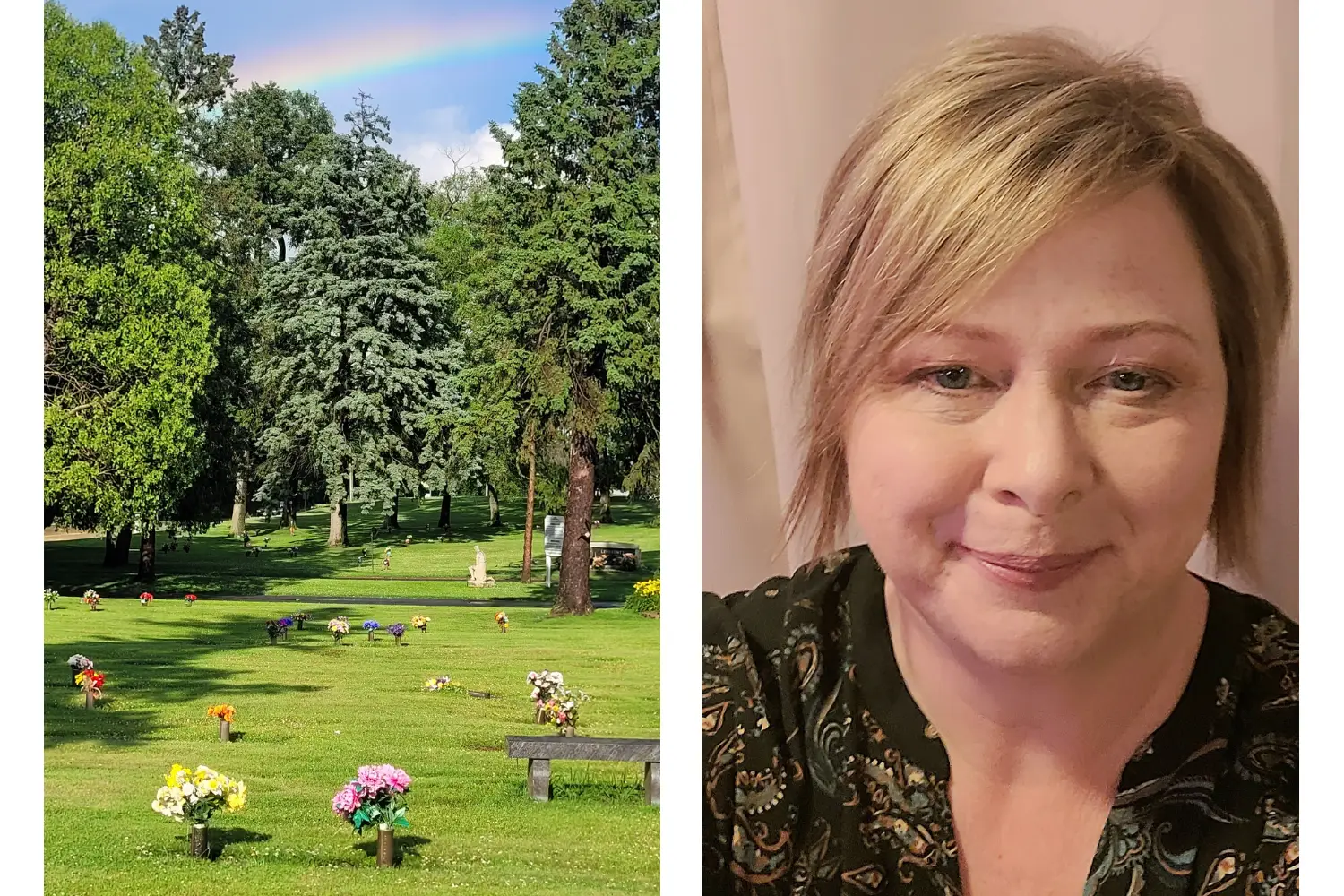
When Becky Kanable turned 50, she found herself staring down a truth she could no longer ignore.
Journalism – the career for which she had poured herself into for decades – was slowly draining the life out of her. The deadlines, shrinking staffs and relentless pressure had become too much.
“Working for a newspaper almost killed me,” she said. “I’m serious when I say that.”
Leaving the newsroom wasn’t just a career change. It was a reckoning. Becky needed work that aligned with her values, honored her strengths and allowed her to contribute something meaningful. She didn’t expect that path to lead her to a cemetery.
But it did, and it changed everything about her life.
Today, at 52, Becky is a family services counselor at Roselawn Memorial Park in Madison, Wis., where she helps people plan their final arrangements. It’s work rooted in compassion, clarity and deep human connection. It is exactly the kind of purpose she had been craving.
“I realized I’m in the peace‑of‑mind business,” she said. “People come to me overwhelmed, and I get to help lift that burden. That’s an honor.”
A pandemic, a pivot and a new perspective
Becky’s shift began during the pandemic, when death became a daily topic in the news and in her own thoughts. She watched families struggle with loss, confusion and the logistics that follow a death.
She also remembered the gift her grandparents had given the family decades earlier when they planned their own funerals.
“They made so many decisions ahead of time,” Becky explained. “We didn’t have to guess what Grandma Helen wanted, nor did we have to argue. It was all there.”
That memory stayed with her. As she considered leaving journalism, she kept returning to the idea of helping others experience that same relief.
She began asking her own mother and aunt whether they had made their plans. Becky admits now that she was rather blunt.
“I would start every phone call with, ‘So, have you made your funeral plans yet?’” she said. “I even took a break during the holidays so I wouldn’t ask then.”
Becky’s family understood her heart. But, the conversations opened a door. Becky realized she wanted to help people talk about the one topic most families avoid.
“Death is inevitable,” she said. “It’s one of the few guarantees we have. Yet, we don’t talk about it. I wanted to change that.”
Learning a new industry at midlife
Becky didn’t enter the field through a traditional route. She first explored selling burial insurance and even earning a license to do that. But, the job she hoped for didn’t materialize.
Then her eyebrow specialist mentioned that her sister worked at a cemetery. Becky followed the lead, applied and soon found herself in a mausoleum office learning the ropes of a completely new profession.
“I still wonder how I got here,” she said. “Every day I walk in and see the church cart waiting for a casket. And I think, today it’s not for me. That perspective matters.”
The learning curve was steep. She had to understand burial options, cemetery regulations, vaults, markers, niches, columbariums and the growing world of cremation choices. However, the real education came from sitting with families.
“People handle grief in all different ways,” Becky explained. “Sometimes you can feel the emotion in the room even when no one is crying. You just have to meet them where they are.”
The moment everything clicked
Becky remembers the exact moment she understood the true purpose of her new work.
One Saturday, a woman left a voicemail saying she needed to make sure her plots were “ready” because her husband was in the hospital. Becky went in the next morning to check the paper files, then called the number. The husband answered.
“I didn’t know what to say,” Becky recalled. “I just prayed for the right words.”
She told him everything had been taken care of. The plots were ready and the decisions were made.
“He said, ‘I don’t have any worries,’” Becky recalled. “And I thought, wow. That’s what I do. I help people to not worry.”
That moment cemented her calling.
Helping families avoid conflict and confusion
Becky sees firsthand how pre‑planning prevents family stress. Without clear instructions, adult children often disagree about what their parents “would have wanted.”
“Everyone thinks they know,” she said. “But, when it comes time to write the obituary, suddenly no one remembers anything.”
She encourages people to make decisions while they can regarding where they want to be buried, what type of marker they prefer, whether they want religious symbols and what songs they love.
“You know yourself better than anyone else,” she said. “Planning ahead ensures your wishes are honored.”
It also saves money. Costs rise every decade, and families often overspend when emotions run high.
“By planning ahead, you’re not buying things based on grief,” Becky explained. “You’re not feeling guilty and thinking, ‘I should get Mom a better flower arrangement.’ Planning ahead protects everyone.”
A changing landscape of final choices
One of the biggest shifts Becky has seen is the rise in cremation. In her area, funeral homes report rates of 60 to 70 percent, and national projections suggest cremation could reach 80 percent in North America.
With cremation comes creativity.
“People are unique, and so are the ways they can be memorialized,” Becky said.
She educates families about options they never knew existed, such as niches, glass-front columbariums, cremation benches, urn burials and memorial statues designed to hold remains.
She once heard of a woman who quietly placed her mother’s urn in her brother’s car trunk, thinking he wouldn’t notice.
“He turned and said, ‘I thought you were taking Mom home,’” Becky said. “No one had a plan. That happens more often than you’d think.”
She encourages families to bring urns home temporarily if it helps them grieve, then choose a permanent resting place when they’re ready.
“Every life deserves acknowledgment,” she said. “Memorials matter and so do obituaries because they honor human dignity.”
Finding meaning in stories
Becky’s journalism background still serves her well. She listens deeply, asks thoughtful questions and appreciates the power of a person’s story.
“I always read the obituaries,” she said. “I want to know who this person was so I can acknowledge their life.”
She doesn’t immediately ask about the deceased person. Instead, she waits for the right moment by letting families open up naturally.
“People want to talk about their loved one,” Becky explained. “They want to share the stories. It helps them heal.”
She has even helped a few people write their own obituaries, though she laughs about how AI tools are creeping into that world.
“You can tell when an obituary was written by artificial intelligence,” she said. “There’s no heart in it.”
Reinvention at 50 and beyond
Becky knows many people over 50 who feel stuck or unsure about their next chapter. She understands the fear of leaving a long career and the uncertainty of starting over. But, she also knows the reward that awaits when they do.
“At 52, people think I know a lot,” Becky explained. “They don’t realize I’ve only been doing this for a year and a half. It’s like reverse ageism.”
She advises people to talk about what they want, stay open and trust that the right door will appear, even if it comes through your eyebrow specialist.
“You just have to go forward one day at a time,” she said. “Do your best to make a difference. That’s what matters.”
Becky found meaning in a place most people avoid, and purpose in conversations others fear. She found peace in helping families prepare for life’s most certain transition.
“It’s a privilege to be let into people’s lives at such a vulnerable moment,” Becky said. “I just hope I’m doing the best I can for them.”
For more information
People can connect with Becky on LinkedIn at www.linkedin.com/in/beckykanable.