When Satori Shakoor lost her mother and son within nine months, she described the years following those events as “crawling back from the numb of hell.” The grief was suffocating.
Yet, through that pain, she found an unexpected path to healing and, ultimately, a new purpose that continues to transform lives. That path was storytelling.
After six years of processing her loss, Satori began sharing her story publicly through The Moth, a national storytelling organization. Each time she told her story of loss, she noticed something profound happening.
“Telling my story was healing me,” she recalled. “It was freeing me and it seemed to be freeing the listeners who heard it.”
Letters and emails began pouring in from people around the world who thanked her for giving voice to what they felt, but couldn’t say. Those messages made her realize that storytelling wasn’t just self-expression. It was service.
“I began to think maybe storytelling is a form of healing, not just for me, but for others, too” she said. “I found that it was my purpose.”
Healing a city through stories
In 2012, while living in Detroit, that realization evolved into a bold idea.
“Wall Street had crashed, Detroit was under emergency management, and the city was struggling with abandoned homes, gentrification and water shutoffs,” Satori said. “I sat one morning in my friend’s garden and wondered if storytelling helped to heal me, could it heal the city of Detroit?”
With no budget, but a burning conviction, she decided to try.
That summer, Satori launched what became the Secret Society of Twisted Storytellers, a live storytelling platform designed to connect humanity, heal communities and uplift spirits through true, personal stories told on stage.
The first event sold out 45 seats. Within months, the audience grew so quickly the show had to move to larger venues. Over time, the stage welcomed an extraordinary mix of everyday citizens alongside national figures such as George Clinton and the late Dick Gregory.
Each event followed a curatorial theme, with Satori coaching storytellers to share a story from their life that carried emotional truth. The evening often blended spoken stories with live music, dance and digital art. The events created full-sensory experiences rooted in humanity and hope.
Fourteen years later, the Secret Society of Twisted Storytellers still thrives in Detroit’s cultural heart by drawing audiences from around the world.
The art and science of storytelling
Through her work, Satori discovered that storytelling engages heart and mind in unique ways.
“Storytelling is an art, a craft and a science,” she explained. “When we learn how to tell our stories well, our brains release oxytocin and dopamine, which are hormones that build empathy and connection.”
She teaches storytellers three key tools: keep it simple, start in the action and include real stakes.
“A story should be so clear that anyone from age 8 to 80 can follow it,” she said. “It should start with action, not long introductions, but the moment something begins to happen. For example, when your car hits black ice on I-75, when you get the phone call or when you make the choice that changes everything. That’s where a story starts.”
What’s at stake is equally important, she said.
“The higher the stakes, the more compelling the story,” she explained. “What’s at risk? What could be lost or gained? That’s what keeps listeners leaning in.”
Satori’s coaching has grown into workshops for universities, government agencies, nonprofits and corporations — anywhere people want to use stories to communicate with more authenticity.
“Storytelling is the most effective delivery system for information and ideas,” she said. “When people use it, they connect in ways that PowerPoint slides never can.”
The power of listening
For Satori, storytelling isn’t only about the teller. It’s also about the listener.
“I believe listening is a revolutionary act,” she said. “At the highest level, it’s love.”
At every Twisted Storytellers event, Satori reminds the audience that their role is active, not passive.
“I tell them that listening is generosity. It’s something you volunteer to another person,” she explained. “You have to give up your judgments and your opinions, and just receive what’s being said.”
That kind of deep listening, she believes, is rare in today’s sound-bite culture, but it is absolutely essential.
“We’re taught to listen in order to agree or disagree. But real listening means hearing beyond the words. It’s where empathy begins,” Satori explained.
The results are visible at every performance.
“You can hear a pin drop,” she said. “Then, there’s laughter, tears and people holding hands with strangers. Storytelling reminds us that we all share the same humanity.”
Rewriting the narrative for women over 50
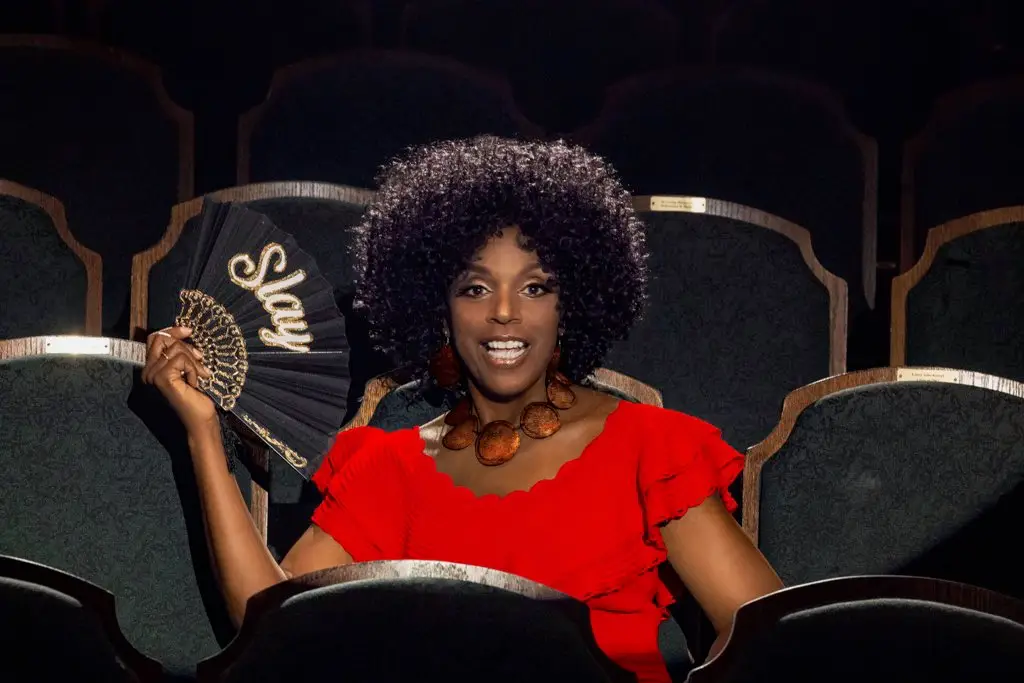
In addition to running the Secret Society of Twisted Storytellers, Satori continues to perform as a writer, singer and actor. Her most recent project, “Confessions of a Menopausal Femme Fatale,” is a one-woman storytelling concert film available on Amazon Prime, Apple TV and Google Play.
The project grew from her own journey through perimenopause, which she described as a confusing and isolating time that few women discussed openly.
“When I started going through it, I asked older women what was happening to me, and they all said, ‘I don’t remember,’” Satori recalled. “It was like this great taboo. So, I promised myself that when I got through it, I would write about it honestly so other women wouldn’t have to face it alone.”
The resulting performance is funny, raw and deeply relatable. Beyond the physical realities of menopause, it challenges the societal lens that defines a woman’s worth by her youth or reproductive ability.
“At 45, 50 or 60, are you telling me that all this experience and all these talents I’ve developed, no longer have value because I’m no longer considered attractive?” she asked. “That’s preposterous. I believe menopause should be a rite of passage as well as a celebration of freedom and creativity.”
Through the film, she aims to dismantle shame and spark conversation.
“When women talk about it, they realize they’re not alone,” she said. “When we free ourselves from silence, we reclaim our power.”
From funk to film to purpose
Satori’s path to storytelling has been anything but ordinary. She began her creative life in Detroit, playing violin professionally by age 15 on Motown records.
She later sang with George Clinton’s Parliament-Funkadelic as part of “The Brides of Funkenstein,” performing in front of crowds of 10,000 or more.
Eventually, she transitioned into acting and musical theater, starring in productions such as “Menopause the Musical” and “Da Kink in My Hair.” She also co-founded Toronto’s Obsidian Theatre Company, which is now one of Canada’s most prominent and diverse performing arts organizations.
Looking back, she said every stage of her career prepared her for the work she’s doing now.
“All of it — music, theater, grief and aging — taught me that stories are how we understand ourselves and one another,” she said. “They’re how we heal.”
Helping others find their voice
Satori now devotes much of her time to coaching others to find their voices and share their experiences. Some of her storytellers have never spoken publicly before, while others are seasoned performers.
Regardless of background, she sees each person as a vessel of wisdom.
“Every human being has something extraordinary inside them,” she said. “Sometimes they just need someone to reflect that back.”
She encourages her students to stand proudly in their truth.
“People are taught not to brag, but to be modest,” she said. “I tell them to claim their accomplishments. You don’t have to boast, just own who you are.”
The results are transformative. As storytellers gain confidence, they begin to understand the value of their lived experience. And as listeners engage deeply, communities grow stronger.
The meaning of life after 50
Today, in her 70s, Satori says her greatest fulfillment comes from helping others express the fullness of their humanity.
“I don’t give advice,” she said. “I believe people already know deep within themselves what they want to do. I just tell them to just do it. Be unstoppable.”
Her own journey embodies that message. Through pain, creativity and perseverance, Satori has built a legacy that connects generations by teaching young and old alike that stories are bridges between hearts.
“If storytelling could heal me,” she said, “it can heal anyone.”
For more information
People can connect with Satori on these platforms:
- Website = www.satorishakoor.com
- Organization website = www.twistedtellers.org
- Facebook = www.facebook.com/SatoriShakoorFilms
- Instagram = www.instagram.com/satorishakoorfilms
- YouTube = www.youtube.com/user/SecretSocietyStories