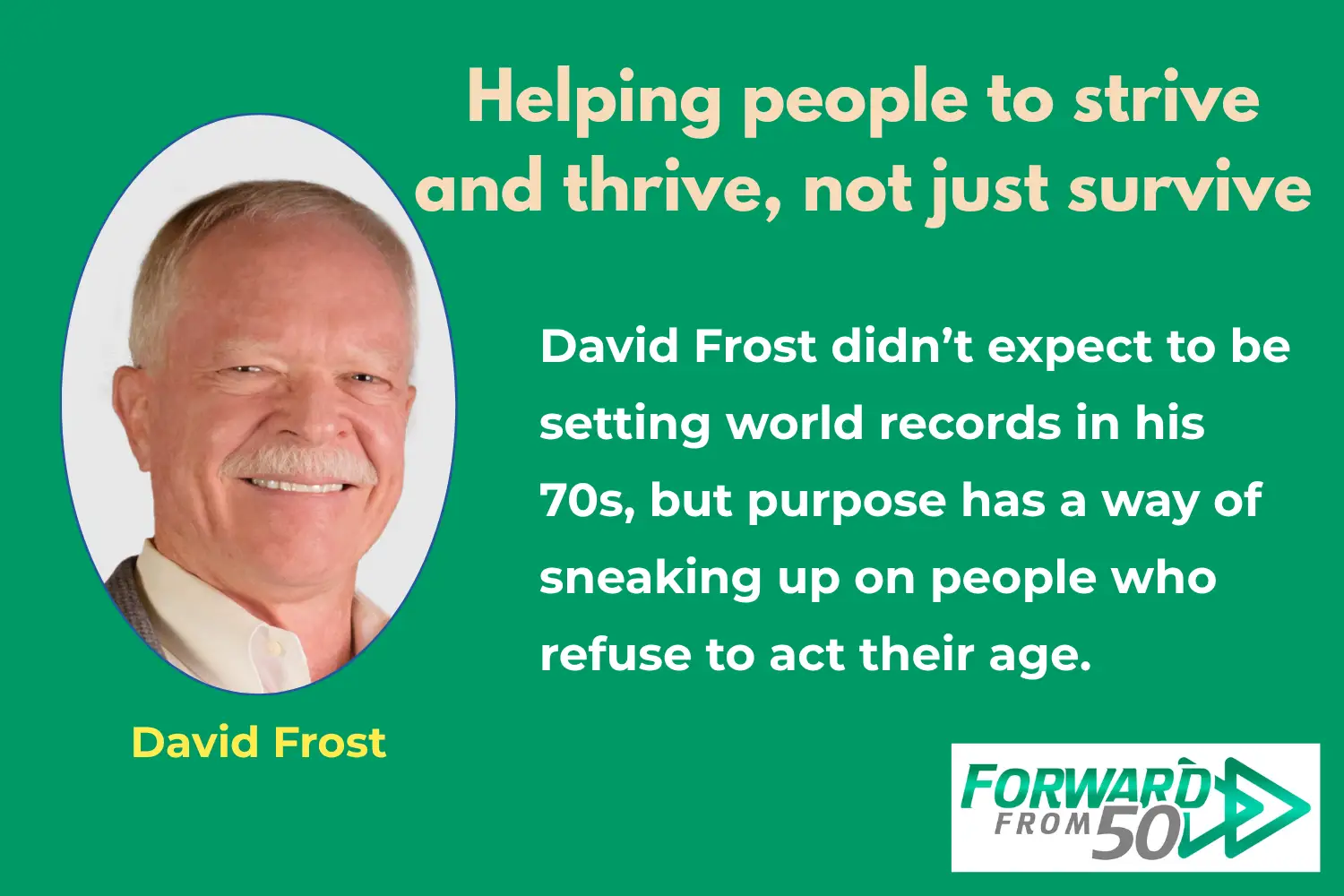
David Frost didn’t expect to be setting world records in his 70s, but purpose has a way of sneaking up on people who refuse to act their age.
At 72, David and four teammates climbed onto indoor rowing machines for a 24‑hour relay. They pushed themselves through fatigue, monotony and more than 189 miles of collective effort. They competed in the 60‑to‑69 age bracket, even though their average age was well north of that.
“We felt pretty frisky,” David said. “Would I do it every day? No. Should you? No. But, was it a nice milestone? Yes.”
That milestone was more than a physical achievement. It was a statement about how he intends to live the second half of his life, and how he hopes others will approach theirs.
For David, meaning after 50 is found in motion, curiosity and a willingness to confront the things that threaten to slow us down. He calls them kryptonite.
Finding the boat again
David’s relationship with rowing began in 1971 when he entered the Naval Academy. He was a slow starter, but he eventually became captain of the heavyweight crew and earned recognition as an outstanding college athlete. Rowing shaped him long before he realized how much he would need it later.
“I dedicated my first book, ‘Kaboomer,’ to my rowing coach,” he said. “He was so instrumental in teaching me about life and perseverance and resilience.”
Life pulled him away from competitive rowing for decades. The Navy, family and career took priority.
Then, at 49, David underwent spinal fusion surgery. Most people would have taken that as a sign to slow down, but David took it as a sign to begin again.
“That’s when life got really interesting,” he said. “You’re starting to acquire a pretty good portfolio of things that other people might have interest in or should be interested in doing.”
He returned to rowing with a renewed sense of purpose, not to chase medals, but to build a life that would allow him to thrive well into his later years.
A wake‑up call at 71
David’s second major turning point came more than two decades later. After a race, he felt a strange sensation in his chest. It wasn’t dramatic, but it was different enough to get his attention. He called his primary care doctor immediately.
“I’m not bashful about asking for help,” he said. “If you sense something, say something.”
The cardiologist ordered imaging and bloodwork. The results were surprising. David had a hereditary marker for coronary artery calcification, which is another description for heart disease. His blood chemistry looked good, but one inflammatory marker – lipoprotein A – was quietly working against him.
“It just so happens that I have calcium in the wrong place,” he said. “I’d rather not have it in my coronary arteries.”
The diagnosis wasn’t a death sentence, rather it was a wake‑up call.
David adapted his training, adjusted his expectations and began learning everything he could about cardiovascular health. That curiosity became the foundation for his next book, “Burden? or Banish!,” which focuses on eliminating America’s top killer.
“Disease means things aren’t easy,” he said. “It doesn’t mean you’re going to die tomorrow. It just means you’re aware of it and you deal with it.”
The mission behind the message
David’s purpose today is rooted in helping people understand their bodies, risks and potential. He believes most people enter their 50s without knowing their kryptonite, and that ignorance can be costly.
“One of the best ways to live long is find out your kryptonite early and then deal with it,” he said.
For him, that means encouraging people to get diagnostic tests, especially heart ultrasounds and calcium scans. It means teaching people to listen to their bodies instead of ignoring subtle signals. It also means reframing aging as an opportunity rather than a decline.
“We have to get older,” he said. “We do not have to act old.”
That philosophy inspired David to launch his company, Well Past 40. It is a one‑man effort to help people see themselves in fitness years rather than calendar years. He uses books, speaking engagements and social media to share practical, science‑backed insights that make longevity feel achievable.
“I want to be late to my own funeral,” he said. “I think that would be fun.”
Sweat as a strategy
David’s advice for seasoned citizens is refreshingly simple. Move more, sweat often, build strength, and eat to live instead of live to eat. And above all, stay curious about your own health.
“Each of us is an athlete, especially if we’re breathing and we can get up from a chair,” he said.
David believes strength is the cornerstone of vitality. It protects against falls, supports metabolism and helps people maintain independence. His second book, “Strong to Save,” focuses on functional strength for Gen X readers, but the principles apply to anyone entering the second half of life.
“Twice a week, get sore and get sweaty for 45 minutes a day,” he said. “That’s enough to offset sarcopenia.”
He also champions grip strength as a biomarker for longevity, a simple tool that can reveal a lot about someone’s overall health. During the pandemic, doctors noticed that patients with strong grip strength often fared better in intensive care.
“There’s this tremendous grip strength biomarker,” he said. “If older people could do one thing, it would be to look on Amazon and find a flying saucer squeezy thing.”
Living with intention
David’s message isn’t about perfection. It’s about consistency. He encourages people to get things right most of the time, not all the time.
For example, enjoy a piece of cake at a wedding, have a glass of wine, laugh at yourself and hum in the shower. Celebrate the small joys that make life meaningful.
But don’t ignore the hard things.
“Diagnostics are X‑factors,” he said. “Those little bit extras that help us set ourselves apart.”
He wants people to understand that their bodies are extraordinary machines with 60,000 miles of plumbing powered by a pump that never rests. Honoring that system means paying attention, asking questions and refusing to accept decline as inevitable.
“We are what we eat,” he said. “It may cost a little more to find farm-to-table, but it is so important.”
David’s purpose is to help people thrive and strive, not just survive. He believes the second half of life can be the most vital, most intentional and most rewarding chapter if people are willing to invest in themselves.
“I ask everyone to look in the mirror and say, ‘I’m a $10 million physical portfolio. What am I going do about it?’”
A life still in motion
At 73, David continues to row, write, teach and inspire. He shares sunsets from San Diego, endurance events, and practical health insights on social media. He especially encourages veterans to reach out for free copies of his books. He also remains committed to helping people discover what gives their lives meaning after 50.
“Whether you think you can or you cannot, you’re right,” he said.
For David Frost, the second half of life isn’t a slowdown. It’s a long, steady pull toward vitality, purpose and contribution. And he’s determined to help others find their own rhythm, one stroke at a time.
For more information
People can connect with David on these platforms:
- Website = www.wellpastforty.org
- Email = dave@wellpastforty.org
- Facebook = www.facebook.com/profile.php?id=61566287635299
- Instagram = www.instagram.com/davidemersonfrost
- LinkedIn = www.linkedin.com/in/davidefrost
David’s books are available on Amazon and in other bookstores, including “Kaboomer,” and “Strong to Save.”
If you order one of David’s books from a link above, Forward From 50 may receive a small commission at no extra cost to you.