At an age when many people begin pulling back from the world, Sue Donaldson started pulling more people into her home.
She invited lonely college students to dinner. She hosted widows, young mothers, singles and neighbors who barely knew one another. Sometimes she served simple soup and sometimes she lit candles so nobody would notice the dust.
What mattered was not the meal, it was the connection.
“If God wanted us all alone, He would have given us each our own planet,” Sue said.
That belief became the foundation for her work after 50. It shaped her books, speaking ministry and podcast. More importantly, it gave her a renewed sense of purpose during a stage of life when many people quietly wonder if their best years are behind them.
Instead of slowing down, Sue leaned deeper into hospitality, conversation and helping people to feel seen.
“In the past, I have done hospitality because I’ve been lonely,” she admitted. “Even though the people I invite may be lonely, I’m the one who ends up getting blessed.”
Creating connection in a disconnected world
Now in her 70s, Sue lives on the California coast with her husband. Her days are filled with writing, mentoring and finding ways to gather people around a table.
The gatherings are not elaborate productions, which is part of her message. Hospitality has nothing to do with perfection.
“It’s not Martha Stewart hospitality,” she explained. “When we open our homes, we give people an opportunity to see God’s welcoming heart.”
For decades, Sue spoke and wrote about hospitality primarily for Christian audiences. But, after turning 50, the message became more personal and more urgent.
She watched people her age grow isolated, friends passed away or moved, and adult children became busy with careers and families. Many older adults retreated into routines that left little room for new relationships.
Sue wanted to push back against that trend.
“We can get in our cocoon,” she said. “We think we can’t learn new things anymore or make new connections, but we can.”
She believes many seasoned citizens underestimate how much they still have to offer others. For her, that realization became especially clear during holidays.
One Easter, Sue hosted 19 people in her home, including several singles who otherwise would have spent the holiday alone. Some were divorced or widowed while others were simply disconnected from family.
“The whole idea is to invite single people because they don’t get to be part of a family unless you invite them,” she said.
She has seen the same need among college students. Years ago, Sue and her husband began informally “adopting” university students for meals and holidays. One experience with her own daughter reinforced why it mattered.
While hosting a college student for dinner, Sue received a phone call from her oldest daughter, Bonnie, who attended the University of Southern California.
“I told her we couldn’t talk because our college student was there for dinner,” Sue recalled. “She got sad because during four years at USC, not one family ever invited her over for dinner.”
That moment stayed with Sue.
“Younger people think older people don’t want to spend time with them, and older people often believe younger people don’t want to spend time with them,” she explained. “But, everybody wins when they connect.”
Finding purpose through conversation
Much of Sue’s work centers on helping people communicate more deeply.
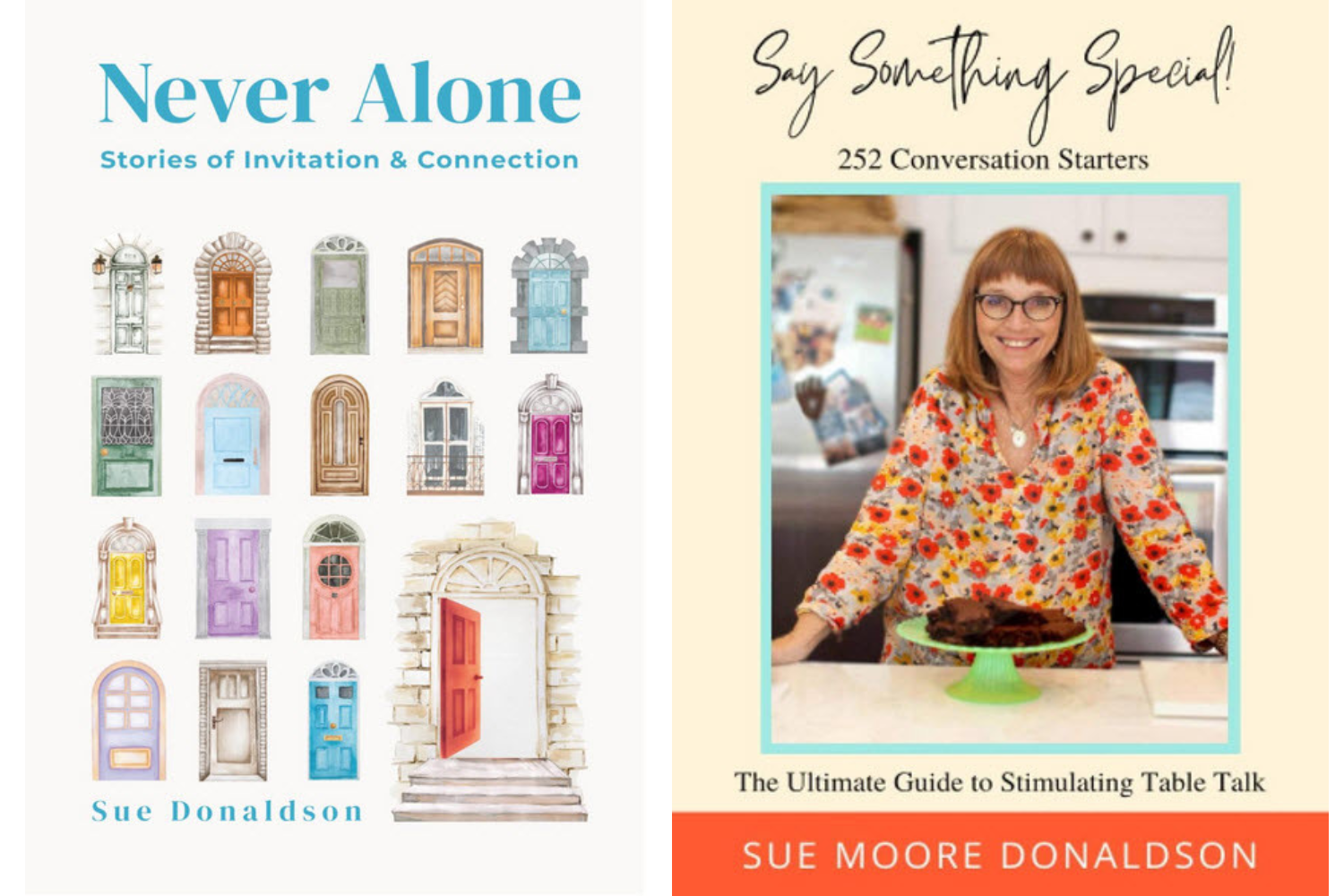
One of her books, “Say Something Special,” contains hundreds of conversation starters designed to move people beyond surface-level small talk. The idea grew from her own experiences around dinner tables.
Her brother once attended a painfully awkward party where nobody seemed to know what to say. He broke the silence with a simple question.
“Where were you living when you were 10 years old, and what were you doing?” Sue recalled.
The room came alive. People shared stories about paper routes, childhood homes and growing up in different states. Laughter followed and connections formed quickly.
That’s when Sue realized meaningful conversation did not require extraordinary skill. It simply required curiosity.
“People feel loved when they get asked questions,” she said.
Since then, Sue has used thoughtful questions everywhere from dinner parties to river cruises. One question especially resonated with strangers gathered around a table during a two-week cruise.
“What is something you failed at, and what did you learn from it?”
The answers became emotional and deeply personal.
“One woman later told me she had never heard her husband talk about his divorce and how he felt he failed as a husband,” Sue said.
Moments like that convinced her that conversation itself can become a ministry.
“It helps people feel seen and heard,” she said. “And that’s something many people are starving for today.”
A new chapter after 50
Sue did not originally envision herself becoming an author and speaker later in life.
As a younger woman, she taught English and spent time serving overseas through Wycliffe Bible Translators. She eventually earned a master’s degree and raised three daughters.
But after 50, her focus sharpened. She increasingly felt called to encourage others who were lonely, disconnected or unsure how to move forward in the second half of life.
That calling eventually inspired her book, titled “Never Alone.”
The project began during a vacation with her daughter, Bonnie, in Iowa. Sue showed Bonnie a rough draft for a possible new book idea.
Bonnie responded enthusiastically to the suggestion.
“You need to choose 12 of your most compelling stories and put the Bible into them,” she told her mother.
Sue spent the long drive home brainstorming ideas. The final book featured stories about people who felt abandoned by others, isolated by life circumstances or distant from God.
At its core, the book carried an important message that nobody has to remain alone.
The response surprised her. People began using the book in Bible studies even though that was not her original intent. More importantly, readers connected emotionally with the stories.
Sue believes that storytelling becomes more powerful with age because older adults finally recognize how seemingly unrelated life experiences work to fit together.
“It all works together like a puzzle,” she said. “Even if you can’t see it at first.”
Learning to let go
One lesson Sue continues learning after 50 is how to release things gracefully. For six years, she hosted her own podcast called “Welcome Heart: Living a Legacy Life.” She interviewed guests about the legacy they hoped to leave behind.
Recently, Sue sensed it might be time to step away.
“I don’t feel like it’s a failure,” she explained. “Sometimes saying no to one thing opens the door for God to lead you in a different direction.”
That perspective reflects the wisdom she believes many older adults need.
Purpose after 50 is not about clinging desperately to old identities. Sometimes it means embracing change and allowing gifts to evolve.
“Your gifting can change,” Sue said. “Be willing to say no to things you shouldn’t be doing anymore.”
She points to her brother as an example. After years working professionally as a graphic designer and later with Wycliffe, he now spends his days painting at age 82.
“There are so many things you can start later in life,” she said.
Sue also believes people often discover their gifts by listening carefully to trusted friends.
“I would tell people to ask a close friend what gifts they see in you,” she said. “Sometimes other people can see things we can’t see ourselves.”
Living with intention
Several years ago, Sue attended a Bible study where someone requested prayer for his elderly mother who was beginning to show signs of dementia. The moment shook her.
Sue quickly calculated how many mentally sharp years she might realistically have left. Instead of creating fear, the realization created focus and she began intentionally asking people a new question.
“What legacy do you want to be known for when you die?”
The answers became the foundation for her podcast and much of her current work. She encourages people not to wait until the end of life to think about legacy.
“Don’t wait until after you’re dead and people say nice things at your memorial service,” she said.
Instead, Sue believes purpose grows through ordinary acts of generosity, curiosity and connection. It may be a shared meal, thoughtful question or creating a welcoming home.
Simple things can create lasting impact, and for Sue, trust after 50 has meant opening the door wider than ever before.
For more information
People can connect with Sue on these platforms:
- Website = www.welcomeheart.com
- Facebook = www.facebook.com/sue.m.donaldson
- Instagram = www.instagram.com/suemooredonaldson/
Sue’s books, including “Never Alone” and “Say Something Special,” are available on Amazon.
Her podcast “Welcome Heart: Living a Legacy Life” is available on iTunes and Spotify.