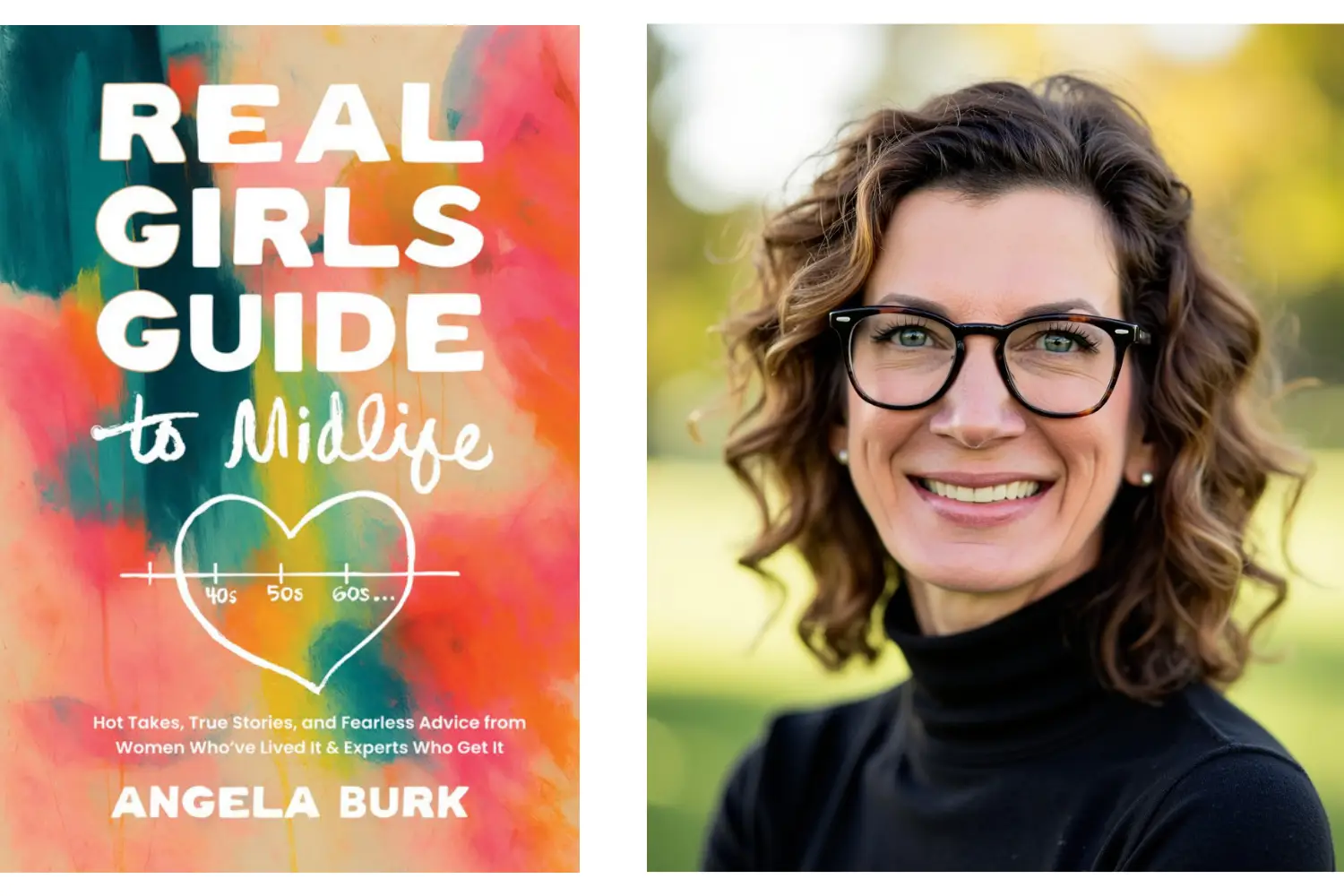
When Angela Burk retired from a 30‑year career in high‑tech marketing last December, she expected to find the usual relics of a long professional life tucked inside her desk. What she didn’t expect was the rediscovery of herself.
Buried beneath years of files was a red folder she had assembled at age 35, during a season of upheaval marked by new motherhood, shifting hormones and a career crossroads.
Inside were chapter outlines, questions and a loose structure for a book she never finished. As she read through the pages two decades later, she realized something startling.
“So many of the questions I had and the topics I was struggling with at that time are the same ones I had now,” Angela said. “I looked around my circle and nobody was talking about those things.”
That silence became the spark for “Real Girls Guide to Midlife,” a raw, humorous and deeply honest look at the transitions women face in their 50s.
Angela gave herself until April to decide whether she could write the book. When the month arrived, she woke up one morning with a new mantra: “Why the hell not?”
A life full of transitions
Angela, now in her mid‑50s, is navigating a season of life that looks different from many of her peers. She has three children, ages 23, 20 and 15, and her youngest still lives at home. Her fiancé lives in Australia and has four children of his own, giving the couple a combined brood of seven.
The long‑distance relationship works, she said, because she stopped believing there was only one “right” way to build a life.
“If I allowed myself to get locked into that one definition of what a relationship would look like, I would have missed this amazing opportunity,” she explained.
Parenting a teenager at 55 also brings its own surprises. Angela laughs when she describes how differently she parents her youngest compared to her older boys.
“I think I’m tired because I pick my battles very selectively,” she admitted.
Her son often asks at 9 p.m. if the two of them can go out for yogurt. Her older boys tease her about it, insisting she never would have done that when they were young.
“They’re right. But, life is different now,” Angela explained “I look around and think, I’m not doing anything. So, yeah, let’s go do it.”
When the nest empties and the silence grows
Like many parents, Angela felt the shift when her older children moved out. The quiet was jarring.
“Not hearing their voices and not smelling their smells or hearing them run down the hallway… some of these changes are very jarring,” she explained, noting the feeling goes even deeper. “We begin to look at our lives as if they don’t belong to us. I felt like I was losing parts of myself that made me.”
That sense of disconnection is one of the reasons she believes women need to talk more openly about midlife. Whether or not they have children, women face crossroads involving identity, relationships, appearance, hormones and purpose. Yet, many feel they must navigate those transitions alone.
Angela’s own mother, who is only 19 years older, never talked about her experiences.
“It’s just not something that was shared,” Angela explained.
Stories women tell themselves
One of the central themes in Angela’s book is the internal narrative women carry for decades. Many of those stories, she said, are rooted in conditioning.
“We are taught to be quiet, to keep the peace and play small,” she explained. “We exist to make other people comfortable.”
Over time, those beliefs become so ingrained that women begin editing themselves out of their own lives. Whenever they say yes even when they want to say no, women put their happiness last. They believe rest is a luxury they don’t deserve. Angela had to unlearn those patterns herself.
“The idea of rest and saying, ‘I am tired, I need help,’ is very foreign to a lot of us women,” she said. “But, rest is nourishment. It allows your mind, spirit and emotional equilibrium to come back to calm.”
She now teaches women a simple phrase – “I am not available” – delivered with no explanation, apology or essay.
“Consisting of only three words, it is a very short, but complete sentence that is very empowering,” Angela explained.
Reclaiming what was always there
Angela believes midlife is not a crisis, but rather a reclamation when women can finally become the women they had been editing for decades.
That shift begins with naming what needs to change. In her book, she encourages women to identify one thing they are done carrying and one thing they want to reclaim.
“Treat it like a personal contract to yourself,” she explained. “Midlife is not about blowing up your whole life. It’s about naming one belief, one habit or one expectation that you want to let go.”
She also encourages women to say their needs out loud.
“It’s one thing to think it,” she said. “Saying it out loud and then putting action behind it is so important.”
Angela practices what she preaches. When she decided to write her book, she didn’t wait for a perfect plan. She simply began.
“You don’t always need a roadmap, instructions or permission,” she said. “Just begin.”
The power of sharing our stories
Writing the book opened doors Angela never expected. Women began sharing their own stories with her and experts offered insights. Her friendships deepened and conversations changed.
“The lunches I have with my girlfriends now are very different than they were nine months ago,” she said. “The more I started to share, the more I attracted people who were willing to share.”
Angela realized she wasn’t alone.
“This book along with my Substack and sharing my story made me realize I am not crazy. I am not alone and I don’t have to suffer,” she explained.
That validation is one of the reasons she believes women should speak openly about their experiences.
“Even just the ability to say out loud, ‘Hey, I’m struggling with this thing,’ is pretty powerful,” she said.
A guide written by a “real girl”
Angela describes her book as raw, vulnerable and unpolished.
“I’m literally just a real girl in Morgan Hill, Calif., who is trying to figure out this stuff without a handbook or playbook,” she explained. “I am just taking all these changes as they come.”
She writes with humor and honesty, including the occasional curse word. She also writes with the hope that younger women, including her two sisters in their 30s, will benefit from the conversations she never had.
“Back then, I wish we would have had more conversations just to know what’s coming,” she said.
Looking back, moving forward
If she could go back, Angela wouldn’t change her life, but she would change how she saw herself.
“I wish I would have embraced the idea that I was always enough,” she said. “And I wish I would have been a little bit less silent.”
Today, she is anything but silent. She is building a new life, nurturing a long‑distance relationship, parenting a teenager, writing regularly and helping women reclaim the parts of themselves they thought were lost.
And it all started with a red folder she almost threw away.
For more information
People can connect with Angela on these platforms:
- Website = www.realgirlsguide.com
- Substack = www.realgirlsguide55.com
- Facebook = www.facebook.com/realgirlsguide
- Instagram = www.instagram.com/realgirlsguide55
- LinkedIn = www.linkedin.com/in/angela-burk-a510516
Angela’s book, “Real Girl’s Guide to Midlife,” is available on Amazon and in other bookstores.